

Masking in autism and ADHD: why it happens and what it costs

You might know the moment. You get home, close the door and the effort stops. Your face relaxes. You stop checking how you're sitting or what your hands are doing. Only then do you notice how hard you've been working all day.
Or it might be smaller than that. You rehearse a phone call before you make it. You keep still in a meeting when your body wants to move. You laugh at the right moment, then go over the conversation later to check you got it right.
This article is for anyone who does something like this and is starting to wonder why. For a lot of people, it turns out to be part of being neurodivergent, whether that's autistic, ADHD or both. You might have a diagnosis, be waiting for one or just be wondering. Wherever you are with it, you're welcome here.
A note on the word "masking". I've used it because it's the word most people search for. Researchers sometimes call it "camouflaging". You might think of it as being polite, keeping it together or just being professional. If "masking" doesn't feel right, use whatever words fit for you. You don't need a diagnosis for anything here to apply.
What masking can look like
Masking means watching yourself and adjusting, so you don't stand out or get judged. Often it's so automatic that you only notice it when it stops.
What gets hidden varies from person to person. For some people it's mostly social: following scripts, copying how other people talk or forcing eye contact that feels uncomfortable. Autistic people often describe it this way. For others it's more about focus and time. You might over-prepare for everything, build systems so nobody sees you forget things or stop yourself saying something before it comes out. People with ADHD often describe it like this.
If you're an autistic ADHDer, you might be doing both at once. You might be hiding restlessness and sensory overwhelm in the same moment, or covering needs that seem to pull in opposite directions. Many people recognise a bit of all of this, whatever label they use.
Why masking happens
Masking usually starts early, and for good reasons. You might have been corrected, told off or laughed at for the way you naturally did things. Learning to hide it helped you get through school, keep a job or make friends. It made sense at the time.
The difficulty is that it can keep going long after the reason has gone. What started as protection can turn into habit, something you do even with people who would accept you as you are. That isn't a failing. It's what happens when something has worked for a long time.
For some people, masking isn't only about autism or ADHD. If you're also LGBTQ+, you might have been hiding your sexuality or gender at the same time, and it can be hard to tell where one ends and the other begins. You won't need to separate them out to get support. There's more on my LGBTQ+ counselling page.
What masking can cost
Masking takes energy, even when it feels automatic. Many people need long stretches alone to recover from days that others seem to manage easily. The National Autistic Society describes masking as something that can lead to exhaustion, mental health difficulties, low self-esteem and losing your sense of who you are. BACP has described a similar pattern of exhaustion and burnout in people with ADHD.
Over time, this can build towards burnout. Researchers who first defined autistic burnout pointed to masking as one of the things that can contribute to it. Research has also found a link between masking and anxiety, low mood and poorer wellbeing, although it isn't yet clear whether one causes the other.
Masking can also mean your needs go unnoticed. If you seemed to be coping, people may not have seen that you were struggling, and that includes professionals. The NHS notes that masking can make autism harder to recognise, especially in women, although men mask too.
Some people find that after years of adjusting, they're not sure what they actually like or need. If that has left you with a sense of shame or not being good enough, there's more on my low self-esteem counselling page. All of this is something you can bring to counselling.
Noticing your own patterns
If you'd like to, you can try one small question. Before you do, pick a moment when you feel fairly settled, not the end of a draining day. Give it a minute, no longer. If you notice numbness, racing thoughts or a sense of shutting down, that's your cue to stop. Stopping is completely fine.
The question is: is there a place, or a person, where you notice you relax a little more? You don't need to do anything with the answer. Just notice it.
Afterwards, it can help to come back to the room around you. You might feel your feet on the floor, look around and name a few things you can see, or have a drink of water. If you'd rather not try the question at all, that's fine too. Even reading this far is enough.
Do you have to stop masking?
No. Unmasking isn't all or nothing, and it isn't always safe or sensible everywhere. Some workplaces, families or situations might not be ready for it, and you're the best judge of that.
What can help is having more choice. That might mean noticing when you're masking, what it's costing you and where you might be able to ease off a little. We can look at that together, at your pace, without it becoming another thing you have to get right.
How counselling can help
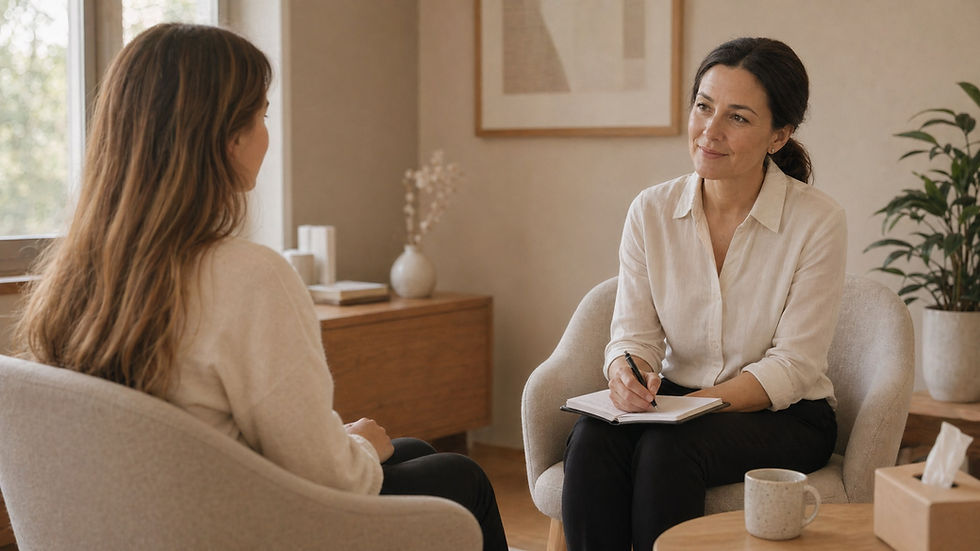
You don't need to mask in our sessions. Eye contact isn't expected, and you can rest your eyes wherever feels comfortable. There are fidget toys in the room, and the lighting can be turned up or down to suit you.
You're the expert on your own life, so you lead. I won't set homework or try to change how you come across. We can look at when you mask, what it has cost you and what feels right to keep. If putting things into words is hard, we can take it slowly, or you can write things down instead.
Autism and ADHD are among my main areas of interest and training. My training includes Working with Autism with Counselling Tutor, and the Self-Determination Model of Therapeutic Support for Adults with ADHD with BACP. You can read more about how I work on my autism counselling and ADHD counselling pages, and about my approach on my neuro-affirmative therapy page. You're welcome here, exactly as you are.
Making sense of it
There's a lot in this article, and you don't need to take it all in at once. If you only keep a few things from it, these are the ones I'd most want you to know.
Masking means watching and adjusting yourself so you don't stand out. It's often so automatic you barely notice it.
It usually started for good reasons, and it may have helped you get by.
It takes energy, and over time it's been linked with exhaustion, burnout and low mood.
You don't have to stop masking everywhere. Having more choice about it is enough.
You don't need a diagnosis to talk about any of this.
If something here feels familiar, you're welcome to book a free 15-minute telephone consultation. It's a friendly, no-obligation way to see if it feels like the right fit, and there's no pressure to share more than you feel ready for. I offer sessions in person in Whitefield, by video, by telephone and on walks. You can get in touch here.
If you're finding things very hard right now, you don't have to wait for counselling. You can speak to your GP, or call NHS 111 and choose the mental health option. Samaritans are available any time, day or night, on 116 123. If you or someone else is in immediate danger, call 999 or go to A&E.
Sources
National Autistic Society: masking guidance
BACP: Unmasking ADHD through therapy (2024)
Hull, L. et al. (2019). Development and validation of the Camouflaging Autistic Traits Questionnaire (CAT-Q). Journal of Autism and Developmental Disorders, 49(3), 819–833. https://doi.org/10.1007/s10803-018-3792-6
Raymaker, D. M. et al. (2020). "Having all of your internal resources exhausted beyond measure and being left with no clean-up crew": Defining autistic burnout. Autism in Adulthood, 2(2), 132–143. https://doi.org/10.1089/aut.2019.0079


